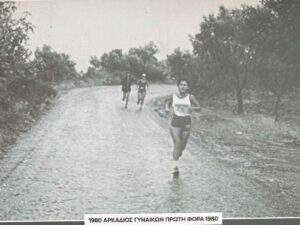
While women were excluded from the ancient Olympic Games, the Heraean Games held in Olympia gave parthenoi (unmarried young women) the opportunity to participate in a running competition. The games were organised by a group of sixteen women, who were also charged to weave a peplos for Hera (just like women did for Athena in Athens) and arranging choral dances. Competitors raced in three different age categories. They wore a short chiton, a dress cut above the knees, which left the right shoulder and breast bare, and wore their hair down. The winners were awarded a crown of olive leaves and a portion of a cow which had been sacrificed to Hera. But why would the Games be dedicated to Hera, the goddess who was spewed out by her father Kronos, married Zeus and suffered from his polyamory, punished several of his children’s mothers and cast out her son Hephaestus? Because Hera was seen as a protector of women especially during childbirth, a goddess of fertility and lawful marriage. The Heraean Games served multiple purposes, including demonstrating female athleticism, marking a transition into adulthood for young women, and offering a rare opportunity for women to compete and gain respect in a male-dominated society. For the record, women were officially excluded from track and field events at the modern Olympic Games (1896), as Pierre de Coubertin was against their participation. Women first competed in the modern Olympic Games at the 1900 Paris Games, where 22 female athletes participated in sports like tennis, sailing, croquet, equestrian, and golf. In the picture the first woman to run the Arkadi Run in 1980 in remembrance of the 1866 holocaust in the Arkadi Monastery
Running off the beaten track