
When visitors go to museums, they do so for a variety of reasons; to learn about history and culture, find inspiration or enjoy an experience with family and friends. Museums also offer an alternative way to connect with the past and experience unexpected emotions. But it is the stories behind the artifacts that connect the visitors to the ancient or modern history and the potential interpretations.
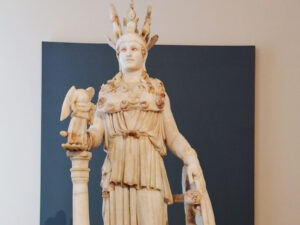
Today a visitor sees at the National Archaeological Museum of Athens the marble statuette of goddess Athena and finds out that it is the most faithful copy of the cult statue of the Athena Parthenos erected in the Parthenon in 438 B.C.
The Athenians who would see the original, which was twelve times larger than this, would see Athena wearing the Attic peplos. They would think of the dress woven for 9 months by the ergastines, the noble young women who carried the robe of the goddess to the procession of the Panathenaea in honour of the city’s patron.
They would see the chest of Athena covered by an aegis, an armor made of goat’s skin featuring the head of the Gorgon Medusa and snakes around the edge. And they would immediately think of her father’s birth and upbringing in a cave in Crete where the goat Amaltheia raised him with her milk. But for the goddess of war, the aegis represented her power and defence that created terror to the enemies.
But it was her mother Metis who passed her on the wisdom to choose her battles. No wonder that her left arm rests on her shield. The Athenians could not but observe that, and feel assured that Pallas will protect them from any danger.
When feeling protected you can experience your “golden age” of achievements, creation and a sense of safety that will allow you to be your authentic self without conforming to external pressures and expectations. Isn’t this state a sine qua non for both acting in a more conscious way and improving your well-being?