
A common language and consciousness were among the few elements that united Athenian and Spartan women in ancient times. Otherwise, women in the two cities had very different obligations and rights. Daily life in Athens and Sparta was diametrically opposed. In Sparta, the political system was oligarchic and military organisation prevailed. In Athens, direct democracy for free men who had committed no serious crimes the Ecclesia of the demos (demos a word we read in Linear B tablets )and the Agora were at the centre of daily life.
In Athens, a girl’s fate depended on her family. As a rule, she was married off before the age of 15. (Life was also shorter then) She had no right or say in the choice of her husband. Marriage was a kind of financial transaction arranged by the father or the male guardian of the household. There was also the concept of dowry, which was somewhat different from how we understand it today. The “guarantee,” as it is called, was mandatorily specified in a contract before the wedding and was given by the girl’s family to the groom. As the name suggests, it was a kind of guarantee, meaning it was not intended for immediate consumption. It was a sum of money or assets set aside for a case of emergency. If for any reason the marriage was dissolved, the guarantee was returned to the bride’s family. The women of Athens stayed indoors most of the time.
On the other hand, in ancient Sparta, customs were very different. According to Plutarch, the Spartans believed that women had to be fully physically developed in order to marry. Thus, marriage between adult men and girls before puberty was not a common phenomenon, as it was in other city-states. Furthermore, there was no engagement, and pre-marital contracts were prohibited by law. These included the obligation for the bride’s family to provide a dowry. However, often unofficially, the father made a large donation to his daughter when she got married. In this case, too, the marriage was arranged between the girl’s father and the prospective groom.
Aristotle characteristically refers to them as “household objects,” meaning objects of the home. When referring to women, in particular, those from higher social classes rarely ventured into public spaces. Even when they went to the Agora, they were accompanied by a slave. At home, they took care of their appearance, spent time in the baths, spun yarn, and those who did not have servants raised their children. They had no political or inheritance rights. In all legal matters, they were represented by their guardian, i.e. their husband or father. Similarly, the professions they were entitled to practice were few. Priestesses, midwives, and wet nurses were the most common. (There is evidence that maybe some potters were women in some areas of ancient Iron Age Greece, maybe in due time we shall find out more about these invisible women) Nursing was the most common profession practised by women in ancient times.
On the other hand, Spartan women were a dynamic part of society. They had political rights and could inherit land. As boys had to focus on their military training from an early age, the state took care of the intellectual education of girls. Young Spartan women were not confined to the home, nor were they destined to play a passive role within the household. From a young age, they exercised like boys and were toughened up. Their education was considered crucial, as they were the future “shapers of men.” In other words, they were the ones who would raise strong and courageous men. They did not pay particular attention to their appearance. They dressed simply, without luxuries. Unmarried women usually wore a slit tunic to show off their athletic bodies. When they married, they replaced it with a tunic without a slit. Spartan women dressed much more modestly than Athenian women and took care to keep their bodies fit.
The Conqubines and the Prostitutes In Athens, unlike Sparta, prostitution flourished. In fact, prostitutes were classified into different categories. At the bottom of the scale were the prostitutes. The term comes from the verb “pernemi,” which means “to sell.” Prostitutes, most of whom were foreign women slaves (trafficked just like now), belonged to pimps who kept a portion of their earnings. It was a legal and open professional activity. One step above them were prostitutes who had earned their freedom and worked independently. And at the top of the list were the hetaerae. These were rare women who had a higher level of education. Often from abroad and one of them shaped ancient Athens and its Golden age the other one inspired the highest of Art at the same Era. Unlike ordinary prostitutes, hetaerae did not only offer sexual services. They were “hired” to stand by the side of wealthy Athenians and accompany them to banquets. Many came from higher social classes and therefore had a deeper intellectual culture. They were well paid, and their relationships with their clients were usually long-term and personal. Clients tended to hire the same companions again and again.
Sparta was one of the few city-states where prostitution and the institution of the companion did not flourish However, it was the duty of every free citizen to marry and start a family in order to ensure the continuity of his lineage and his household. At the same time, it was also a sacred religious duty, because the private worship of each family had to be continued. Every home kept religious family heirlooms, which had to be passed on to their descendants. Those who avoided marriage were criticised. Men had to marry by the age of 35 at the latest, and here we should remember Plato, who mentions that anyone who remained unmarried after the age of 35 had to pay a fine.
Things were even tougher in ancient Sparta. There were two fines there… for being unmarried and for being late to marry. The monogamous system prevailed in all cities of Greece, but men had extramarital affairs. In Athens, there was a law prohibiting a man from marrying a woman who did not belong to a family of Athenian citizens.
In Athens, weddings took place in the month of Gamilion, i.e. January. The ceremony lasted three days. On the first day, the bride’s father made offerings to the gods, especially to the goddess Hera. The bride, with reverence and emotion, gathered all her toys and offered them to the goddess Artemis. This was confirmation that she was leaving her father’s house and her previous carefree life behind, because now she would have to devote herself to her husband and her family. This was followed immediately by the washing of the bride and groom with water brought in a special vessel from the sacred spring of Kalliroe.
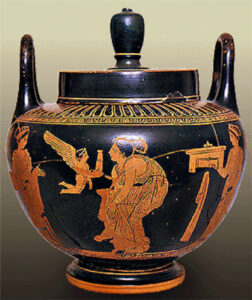
On the second day, the bride’s father hosted the wedding feast, and she herself climbed into a carriage and went to her new home, as shown in the image accompanying this post.
On the third day, the bride accepted the gifts that people wanted to give her, which were always welcome, and she showed her joy. Finally, she held a small wedding ceremony dedicated to the goddess Hera.
In Sparta, marriage took place through “abduction.” According to testimonies, when a young man wanted to marry, he would kidnap the girl he desired. He would then hand her over to a woman, the bride’s attendant, who would cut her hair short, dress her in men’s clothes, put men’s shoes on her, and lay her down on a straw mattress alone in the dark. Then the groom would leave the hall (let’s not forget that in Sparta, men spent a large part of their lives in military camps – herds so that they were always ready for war, so they could only live with their wives after the age of thirty, when they completed their military service and became citizens), he would go to his bride, lift her, and carry her to bed. After spending a little time with her, he would return to the camp. Often, the bride would help arrange opportunities for them to meet in secret. This continued for so long that some even had children before seeing their wives in daylight.
A Spartan woman was not obliged to give a dowry to a man to marry him. Moreover, it was possible for a marriage to take place without the girl’s father having previously agreed to the marriage with the groom’s family. Furthermore, Lycurgus had established a law that girls could be given in marriage without a dowry, so that poor girls would not remain unmarried. However, if a family did not have a son as a legitimate heir, then the father’s property passed to his daughter, Marriage in Ancient Athens and Sparta offers a fascinating glimpse into how two city-states with distinct values shaped the lives of women and their roles within society.
While both viewed marriage as a vital duty, their customs and expectations couldn’t be more different. In Athens, a young girl’s path was largely determined by her family. Most entered marriage before she turned fifteen, with husbands chosen more for their family’s interests than personal preference. These unions served to sustain household traditions and religious practices, with the dowry, known as the “guarantee”, playing a key role. This financial security ensured that if a marriage ended, the woman and her support remained protected.
Life for Athenian women was centred around the home. They diligently cared for their families, raised children, and maintained household rituals. Some also served as priestesses, midwives, or wet nurses, fulfilling vital community roles despite their exclusion from political life. Weddings were grand, joyful events lasting three days, involving offerings to the gods, symbolic farewells to childhood, processions to the groom’s home, and gift exchanges celebrating the union.
In stark contrast, Spartan marriage customs prioritised strength, resilience, and shared responsibility. Girls married later, only once they were fully grown and physically capable of bearing children, a reflection of a society dedicated to producing warrior mothers. Spartan women received education, enjoyed more independence, and could inherit land, manage property, and participate visibly in public life. Marriage often began with a symbolic abduction, after which the groom returned to his military duties, and the couple met secretly until his service was complete.
Despite this unusual beginning, Spartan marriages were highly respected, and love could develop over time. The laws of Lycurgus discouraged financial barriers, allowing all women to marry without a burden. Aristotle observed that nearly two-fifths of Spartan land was held by women, highlighting their significant influence.
Ultimately, both Athens and Sparta regarded marriage as a sacred duty, vital for family honor, religious tradition, and the survival of their city-states. Whether in the quiet intimacy of Athens or the rigorous discipline of Sparta, women stood at the heart of family life, guardians of the next generation, embodying the very essence of societal continuity. This Marriage in Ancient Athens and Sparta: A Tale of Two Worlds Ancient Athens and Sparta shared a language, gods, and certain traditions, but when it came to marriage and the lives of women, the two city-states could not have been more different.
— Athens: A World Indoors In Athens, a girl’s future lay firmly in her family’s hands. Most were married before the age of fifteen, with little say in the choice of husband. Marriage was less about love than about alliances, duty, and preserving the household. Athenian weddings were carefully arranged, often sealed with a dowry or “guarantee”, a sum set aside to protect the bride if the union ended.
Life for Athenian women unfolded mainly behind closed doors. Days were filled with spinning wool, caring for children, and performing household rituals. Public appearances were rare and always chaperoned, often by a slave. Only a few roles were open to them outside the home, priestesses, midwives, and wet nurses. Though their weddings were joyful three-day celebrations with offerings to Artemis and Hera, they marked a profound shift: the end of childhood and the beginning of a life devoted to family.
— Sparta: Strength and Independence In Sparta, the story was entirely different. Girls married later, only once physically mature, reflecting a society obsessed with strength and the birth of strong warriors. Spartan women trained, exercised, and received education—making them formidable both in body and mind. They could own land, inherit property, and move freely in public spaces.
Marriage often began with a ritual abduction. The bride’s hair was cut short, and she was dressed in men’s clothing before being left in a dark room, where the groom would visit briefly before returning to military life. Love and family grew slowly, in secret meetings, until he could finally live at home after completing his service. Unlike Athens, dowries were unnecessary, and even poor girls could marry. Aristotle famously noted that two-fifths of Spartan land was held by women, granting them remarkable authority for the ancient world.
— Two Cities, One Sacred Duty For both Athens and Sparta, marriage was more than a personal milestone—it was a sacred duty to family, gods, and city. In Athens, it was a quiet transition into life within the home. In Sparta, it was a bold step into a shared destiny of strength and survival. Together, these contrasting customs reveal how two great city-states shaped the lives of their women—and, through them, the future of Greece. Way, the women of Sparta became landowners, not because they had received a dowry from their parents. Aristotle writes in “Politics” that two-fifths of the land in Sparta belonged to women, a fact that gave them authority and power. From Childhood to Marriage: A Girl’s Journey in Athens and Sparta.
Childhood Beginnings In both Athens and Sparta, a girl’s life began within the family, but her path diverged almost immediately depending on her city. An Athenian girl grew up largely indoors, under the watchful eyes of her family. Her days were filled with playing with simple toys, helping with household tasks, and learning the skills she would need to manage a home. A Spartan girl, by contrast, experienced an active childhood. From an early age, she exercised outdoors, trained in physical activities, and received an education that prepared her to become the mother of strong warriors.