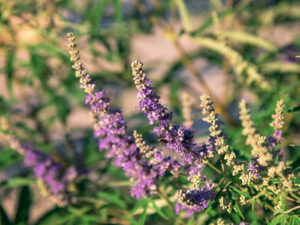

Among the many plants that flourish under the Mediterranean sun, the lygaria—known in English as the chaste tree (Vitex agnus-castus)—holds a special place in women’s history. Its delicate lilac blossoms sway gently in the summer breeze, filling riverbanks and village paths with subtle fragrance. For centuries, it has been more than a plant: it has been a quiet companion to women’s lives, symbolizing balance, resilience, and the intimate bond between nature and femininity.
In antiquity, the chaste tree was considered sacred to Hera and Artemis, both goddesses closely connected with womanhood. During festivals, its branches were used to weave wreaths, while in everyday life it was known for its healing properties in matters of fertility and female wellbeing. Ancient Greek women often placed its twigs on their beds as a symbol of modesty and purity, while at the same time using its seeds and leaves for remedies that supported the body’s natural rhythm.
Beyond symbolism, the lygaria has had countless practical uses. Its branches, flexible yet strong, were woven into baskets and household tools. Its flowers and berries found their way into herbal teas, tinctures, and healing practices. Even today, extracts of Vitex agnus-castus are valued in natural medicine for their balancing effect on women’s hormonal cycles—proof of a wisdomcarried through the centuries.
For the woman traveler, encountering the lygaria along a Cretan stream or in a shaded valley is like stepping into a living fragment of history. Its blossoms are not just beautiful; they tell a story of generations of women who trusted in nature, who sought strength and harmony in its gifts. Walking among its branches, one senses a continuity, a reminder that the female experience has always been intertwined with the rhythms of the earth.
The lygaria, then, is more than a tree. It is a bridge between myth and reality, tradition and science, memory and present experience. It stands as a symbol of how women, across time, have looked to nature not only for beauty and inspiration, but for healing and empowerment. In its quiet strength, it invites us to rediscover our own.