
Let’s talk about Baubo, with a touch of reverence and a healthy dose of sacred mischief ,the mythic figure who proved that sometimes the world isn’t healed through awe and solemnity, but through laughter, shock, and fearless honesty.
Baubo is the old, limping, audacious woman of the Eleusinian Mysteries who dared to do something outrageous: standing before a grief-stricken Demeter, she lifted her skirt and revealed her body , the vulva, the womb, the raw source of life itself. And the goddess, who refused to smile even out of courtesy, laughed. In Baubo we find a radical idea for antiquity: that life, fertility, and the female world are not only solemn and mystical, they are also flesh, truth, humor, subversion.
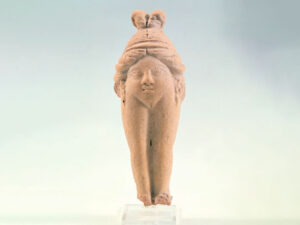
But Baubo did not remain confined to myth. Her figure traveled, transformed, evolved. From Minoan and pre-Greek mother-goddess traditions, to Orphism and the Eleusinian rites; from clay figurines seated with legs wide open, to frog-shaped fertility icons, to startling headless images where the womb becomes a mouth and the breasts become eyes, in Eleusis, Thrace, Asia Minor, Egypt’s Bubastis, even places like Triora in Italy, Baubo appears in many guises. She is not “obscene.” She is unfiltered truth. She is the body speaking when gods fall silent. She is the feminine archetype reminding us that where there is darkness, there is also laughter; where there is death, there is also birth.
And, as always with powers that defy control, Baubo paid a price for her freedom. With Christianity, she was mocked, demonized, turned into a “dirty old woman,” a symbol of shamelessness and moral danger. Her laughter became blasphemy; her body became shame; her courage became threat. But, as happens with every great archetype, she never disappeared.
Baubo survived. She hid in folk tales as the kind, wise “Vavo,” in Thracian and Macedonian fertility rituals, in ribald songs, in carnival traditions, in art and memory. She resurfaces today in contemporary art, feminist narratives, psychoanalysis, and bio-art, wherever we talk about the female body, agency, fertility, healing, and the right to be outrageously alive.
Because Baubo was never just “an old woman lifting her skirt.” She is, and remains, the energy that speaks the truth when others suppress it. She is the force of female vitality, fertility, laughter that liberates, the reminder that humor can be sacred. An energy that never left; it still lives within us, beneath instinct, beneath honesty, beneath everything we dare or don’t dare to name.
To listen to her, we don’t need worship, only courage to laugh, to live, and to admit that life is stronger than fear.